
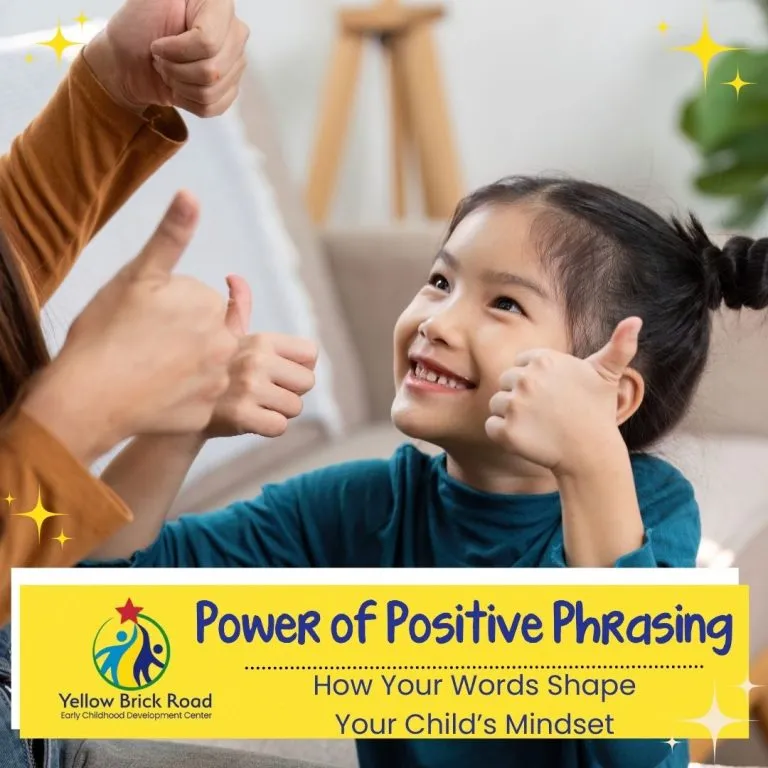
You’re going to slip up and say something you regret… its ok, we’re here to help! At Yellow Brick Road, we believe words matter—especially the ones children hear about themselves. Every “You worked so hard!” and “I love how you kept trying” shapes how a child sees their abilities and their worth.
It’s easy to forget how deeply children internalize our words. The way we talk to them becomes the way they talk to themselves—and that inner voice can either encourage them to try again or convince them to give up.
That’s why our teachers are intentional about the language they use every day.
Why Positive Phrasing Matters
In one of our preschool classroom, a little girl named Olivia was learning to use scissors. She tried to cut out a circle, but it came out jagged and uneven. She frowned and said, “I’m bad at this.”
It would have been easy to say, “No you’re not, it looks great.” Instead, her teacher smiled and said, “You worked so hard on that. Cutting in a circle is tricky, and you kept trying.”
Olivia beamed—and immediately asked for another piece of paper to try again.
That’s the power of positive phrasing: it shifts the focus from being good at something to working hard and improving. That small shift builds what psychologists call a growth mindset—the belief that abilities can grow with effort.
What It Sounds Like in Our Classrooms
Our teachers intentionally replace praise that’s about outcomes (“You’re so smart!”) with praise about effort, strategies, and persistence:
- “You kept building even when it fell down.”
- “I noticed you tried a new way to solve that problem.”
- “You worked with your friends to make that tower taller.”
This kind of language builds resilience. When children know they are celebrated for effort, they’re more likely to take on challenges, persist through frustration, and bounce back after mistakes.
We saw this recently in our PreK classroom during journal time. A student spent almost twenty minutes writing just two letters. When he finished, the teacher said, “I can tell you were focused the whole time. You didn’t give up.” The look of pride on his face said everything—and the next day, he chose journal time first.
How Parents Can Use Positive Phrasing at Home
- Praise effort over results: “You worked so hard on that drawing” instead of “That’s beautiful.”
- Acknowledge persistence: “You kept trying until the block tower stayed up.”
- Notice strategies: “You tried a new way to fit that puzzle piece.”
- Avoid labels like “You’re so smart” or “You’re the best,” which can create pressure and fear of failure.
It can feel awkward at first, but with practice, it becomes natural—and you’ll see how quickly your child’s confidence blossoms.
A Parent’s Perspective
One YBR parent told us, “I used to only say ‘good job,’ and I thought it was enough. But my daughter started giving up the moment something was hard.”
After learning about positive phrasing during a parent-teacher conference, she began saying, “I like how you kept trying,” and “You figured out a new way to do it.”
Within weeks, her daughter stopped melting down during tough moments. Instead, she’d take a deep breath and say, “I can try again.”
Final Thought
Children don’t need to believe they’re perfect—they need to believe they’re capable. When we focus on effort, curiosity, and perseverance, we help children build the internal voice that whispers:
I can do hard things.
Eventually, that voice will become a scream! And that voice will carry them far beyond our classrooms.