
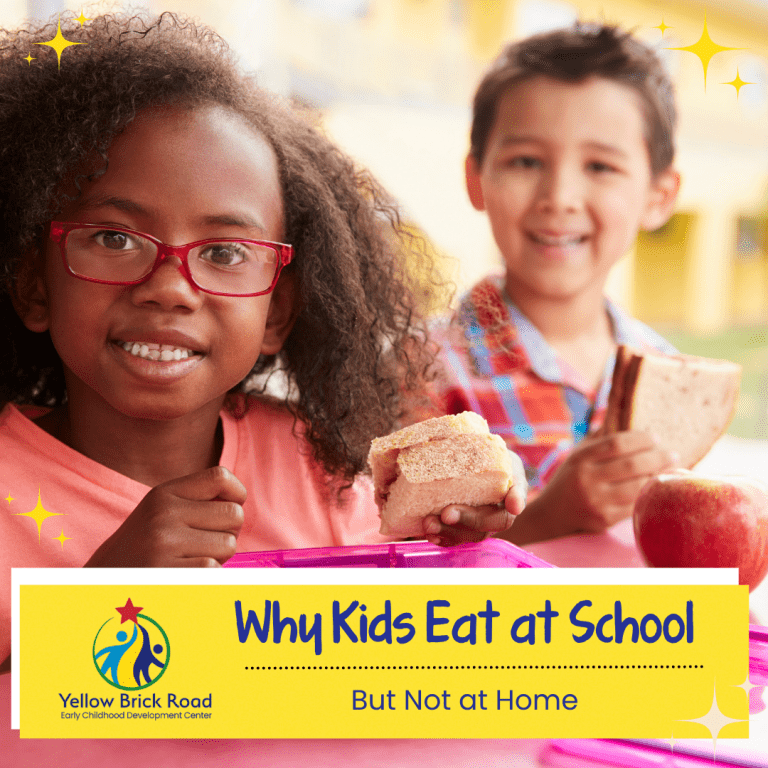
It’s a mystery every parent knows too well: your toddler or preschooler eats everything at school—broccoli, turkey, even lentil soup—but at home, they act like every bite is an insult.
You pack the same snacks, the same milk, even the same spoon. Nothing works.
So why does your child eat so well at school or daycare… but not for you?
At Yellow Brick Road, we see this all the time—and the good news is, it’s actually a great sign. Let’s unpack what’s happening and how you can use it to bring some peace (and maybe a few more bites) to your table.
1. The Power of Peers
Toddlers and preschoolers are social eaters. They love to copy what their friends are doing—especially when it comes to food.
When children sit around a small table at Yellow Brick Road, they see their peers munching carrots or trying yogurt, and something magical happens: they want to be part of the group.
One of our teachers in Plymouth shared, “We had a little girl who refused green beans at home. Here, she saw her friend eating them and said, ‘I want those too!’ Peer modeling works better than any lecture.”
At school, meals are community moments, not pressure moments. And that peer energy is powerful motivation for little eaters.
2. The Calm, Predictable Routine
At home, meals can feel rushed. You might be managing work, other kids, or the evening chaos. At school, though, eating happens at the same time, every day, with the same rhythm: wash hands, find your spot, eat together, clean up.
That predictability gives children a sense of security—and children who feel safe are more open to trying new foods.
In our YBR classrooms, we make mealtime fun and relaxed, not forced. No bargaining, no “just one more bite.” Teachers sit at the table, eat alongside the children, and guide conversation naturally:
“What color is your apple today?”
“This rice is sticky—what does it feel like?”
Meals become a shared experience, not a battle.
3. A Neutral Environment (a.k.a. Less Emotion!)
At home, food is emotional—for everyone. Parents worry about nutrition, health, and picky eating, and children feel that energy.
At school, meals aren’t loaded with that same emotion. Teachers don’t have the same worries or expectations, which makes food feel neutral—and sometimes, neutral is exactly what kids need to explore.
Children are experts at testing boundaries with parents they feel safe with (it’s actually healthy!). So if they refuse dinner with you but eat at school, it’s not rejection—it’s trust. They know you’ll still love them if they say no.
4. Teachers Model Curiosity, Not Control
One of Yellow Brick Road’s core values is Fun, and nowhere is that more visible than at the lunch table. Our teachers turn food into adventure:
- Talking about colors, shapes, and textures.
- Encouraging “taste tests” rather than “clean plates.”
- Modeling trying something new (“Ms. Mayra’s going to try the peas—who’s brave with me?”).
This makes eating less about obedience and more about discovery. When mealtime becomes a sensory experience—full of talking, touching, smelling, and laughing—children approach food with confidence.
5. Trust and Routine Build Appetite
Children eat best when they feel emotionally safe.
At Yellow Brick Road, your child’s day is full of predictability and trust: consistent caregivers, calm transitions, clear communication. That emotional security carries right into mealtime.
When a teacher your child adores sits next to them, smiles, and says, “You can try it when you’re ready,” there’s no fear, no pressure—just safety. That’s the secret ingredient that often makes all the difference.
6. You Can Recreate the Magic at Home
You don’t have to turn dinner into daycare, but you can borrow some of our tricks:
- Eat together. Even five minutes makes a difference—kids eat better when they’re not alone.
- Talk about the food, not the behavior. “What does that crunch sound like?” instead of “Take another bite.”
- Keep a calm tone. Skip the stress. Children feel your energy before they taste the food.
- Offer choice within boundaries. “Would you like carrots or cucumber?” Either answer wins!
- Stay consistent. Offer new foods often, without pressure. It can take 10–15 tries for a child to accept something new.
One mom from our Waconia school told us, “I realized dinner at home was always tense. We started lighting a candle, playing music, and pretending it was YBR lunch. It worked—she started eating again!”
The Yellow Brick Road Difference
We don’t see picky eaters—we see growing humans learning independence, curiosity, and self-trust.
Our Nurturing and Collaborative approach means teachers and parents work together to support healthy habits. Our Communication value means you’ll always know what’s happening in the classroom—what your child tried, loved, or refused—so you can continue the conversation at home.
At Yellow Brick Road, we don’t measure mealtime success by empty plates. We measure it by laughter, curiosity, and the joy of trying something new.
And when your child eats well here—even if they don’t at home—please take it as the compliment it is: it means they feel safe, secure, and happy.